

Dr. Anthony P. Nicholas recently joined the team at Regional One Health, bringing over 30 years of experience and expertise in caring for patients with Parkinson’s disease.
Dr. Nicholas take a patient-centered approach by educating each person about their condition and helping them find the treatment plan that fits their needs and goals.
He sees patients at Regional One Health’s East Campus for the treatment of Parkinson’s disease and other movement disorders, including tremors and dystonia.
A Parkinson’s disease diagnosis can be scary – but with expert medical care, patients can protect their quality of life and continue to do the things they enjoy.
Anthony P. Nicholas, MD, PhD is a leader in the treatment of Parkinson’s disease. With over 30 years of experience, he can help patients access an accurate diagnosis and personalized care to improve their function and quality of life.
Dr. Nicholas joined the neurology team at Regional One Health as the hospital expands its movement disorders program. He sees patients at the East Campus, 6555 Quince Road.
“Patients may hear a diagnosis of Parkinson’s disease and think it’s a death sentence,” Dr. Nicholas said. “That isn’t the case. There may not be a cure, but now there are many, many treatment options, and I can help patients find the treatments that work for them.”
Dr. Nicholas came to Regional One Health after leading a similar program at the University of Alabama-Birmingham. Born and raised in a small coal mining town in northeast Pennsylvania, the medical field sparked his interest from a young age.
He earned a doctorate in human anatomy from the University of Texas-Galveston and considered pursuing teaching and scientific research. However, he also felt drawn to patient care, and ended up staying in Galveston to obtain his medical degree before traveling to Stockholm, Sweden to do research at the renowned Karolinska Institute.
“I wanted to be what we used to call a ‘triple threat:’ you’re seeing patients, doing research, and teaching,” Dr. Nicholas said.
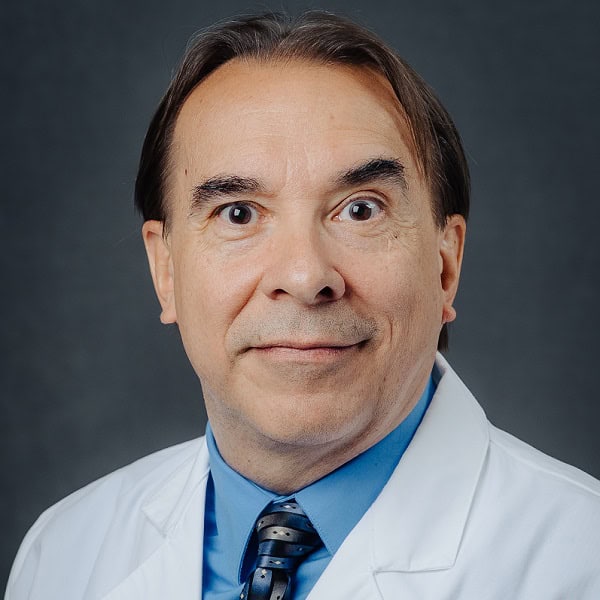
“I’ve always considered my patients as part of the family,” Dr. Anthony Nicholas says. “We promise to do our best to keep them moving and ensure a good quality of life.”
When the chair of UAB’s neurology department offered him an opportunity to teach and care for patients with Parkinson’s, it was a perfect fit. “I found I really liked the Parkinson’s patients,” he said. “There were a lot of new medicines being developed when I started, so it was an exciting time.”
As he gained experience and moved up the ranks, he had an opportunity to switch from basic science lab research to focus instead on clinical research. Again, the opportunity proved a perfect way to blend his love of science, educating new physicians, and hands-on patient care.
After three decades in Birmingham, Dr. Nicholas was ready for a new challenge.
Regional One Health and University of Tennessee Health Science Center were building up their movement disorders program by adding specialists in Parkinson’s disease, multiple sclerosis, cervical dystonia, essential tremor, and more. Dr. Nicholas came on board as chair of the Department of Medical Education at UTHSC and part of the neurology team at Regional One Health.
Dr. Nicholas takes an individualized approach to patient care and incorporates education and support into each person’s treatment plan.
He starts with a thorough evaluation so he can reach an accurate diagnosis. With Parkinson’s, there are many factors that make each person’s diagnosis unique.
Once Dr. Nicholas has a full understanding of a patient’s diagnosis, symptoms, and overall health, he develops a treatment plan using tools including medication and rehabilitation therapy.
“We have medications to treat the main symptoms, which can include tremors, muscle stiffness called rigidity, and slowness of movement,” he said. “Once you replenish the depleted chemicals in the Parkinson brain, patients improve. But you need to find the right amount of medication, and that varies from patient to patient. Some people have side effects, and we’re cognizant of that as well.”
Dr. Nicholas also coordinates with physical and occupational therapists.

“Parkinson’s is a progressive disease, so you need to tweak the medications along with how the disease is progressing,” Dr. Anthony Nicholas explained. “That helps us keep people healthy and moving and lets us guide them through life with Parkinson’s disease.”
“One symptom that we don’t have medication for is imbalance of gait. If a patient has balance or walking problems, having a relationship with the rehabilitation team is helpful,” he said. “They’re right here under the same roof on the East Campus, so it’s easy for the patient to get the care they need.”
Care evolves alongside the patient’s illness.
“Parkinson’s is a progressive disease, so you need to tweak the medications along with how the disease is progressing,” Dr. Nicholas explained. “That helps us keep people healthy and moving and lets us guide them through life with Parkinson’s disease.”
Dr. Nicholas also makes sure patients understand their condition and have access to support resources. “Educating patients about the disease takes some of the scariness away,” he said. “Most folks want a physician who can communicate with them. I spend a lot of time doing that.”
Along with Parkinson’s disease, Dr. Nicholas treats essential tremors and other tremor disorders and cervical dystonia and other types of dystonia. “We’re in the process of building a full team, so we can take care of all movement disorders, start a clinical trials program, collaborate on scientific research, and create a fellowship program to train new movement disorder doctors,” he said.
Dr. Nicholas said he is excited to offer new hope for Mid-South patients with Parkinson’s disease and other neurologic conditions.
“I’ve always considered my patients as part of the family,” he said. “People hear these diagnoses and they think of the worst-case scenario, but with proper treatment, that isn’t the case for most people. We promise to do our best to keep them moving and ensure a good quality of life.”