

Regional One Health’s Emergency Department is a leader in helping address Opioid Use Disorder.
Emergency Department Pharmacist Justin Griner says a three-part approach is key, with a focus on prevention, acute care, and long-term treatment.
Griner recently spoke about the topic as part of the Regional One Health Center for Innovation’s ONExTalks series.
At Regional One Health, Emergency Department providers are helping address the opioid crisis through prevention, acute care, and long-term treatment.
Emergency Department pharmacist Justin Griner, PharmD, MBA, BCEMP, BCPS, FTPA recently spoke about the issue as part of the Center for Innovation’s ONExTalks series. The series, inspired by TED Talks, is designed to spread ideas and concepts that aim to inspire, foster learning, and provoke conversations that have the potential to disrupt the industry and the local ecosystem.
Along with Emergency Department physician Chantay Smartt, MD, Griner founded and co-chairs the hospital’s Opioid Stewardship Committee. Brian Thomas Hawkins, MD, Emergency Department Medical Director, is a key supporter of the efforts as well.
Griner said Opioid Use Disorder (OUD) is a chronic condition in which a person becomes physically and/or psychologically dependent on the drugs, which relieve pain but have the potential to alter the brain’s stress and reward pathways and cause euphoria.
Patients typically build a tolerance, causing them to take larger amounts, increasing their risk of overdose. Patients with chronic pain, trauma, and mental health conditions are at higher risk.
Griner said Opioid Use Disorder can start from legal prescription drugs, which is why health care providers must play a role in addressing the crisis.
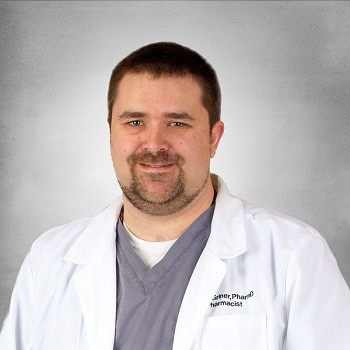
Emergency Department Pharmacist Justin Griner is a leader in Regional One Health’s efforts to reduce exposure to opioids. “We should be trying other things first,” he said. “We can control the way we expose patients to medication.”
“In a clinical setting, an opioid is just another class of medication we use to treat people for pain,” he explained. “We always have the best intentions for our patients. However, sometimes these medications start out being used for good and go down a path where the result is not good.”
In the 1980s-2000s opioids were touted as non-addictive, and by the time Oxycontin was introduced in 1995 opioid prescriptions skyrocketed.
At the time, it wasn’t unusual for patients to be routinely prescribed two weeks’ worth of opioids after an injury or surgery, and opioids were commonly prescribed for a variety of conditions. As patients became addicted, some turned to street drugs like heroin and fentanyl.
Ultimately, studies showed that even a five-day opioid prescription is associated with a 10 percent probability that the patient would still be using opioids a year later; and 30 percent of those who received a 20-day supply were still using the drugs after a year.
“This shocked a lot of people and opened people’s eyes to the importance of being more conservative when prescribing opioids, especially as the first line of treatment,” Griner said.
At Regional One Health, that idea has become part of the culture.
The hospital was part of the initial cohort of the Tennessee Hospital Association’s Opioid Light Pilot Project, which emphasizes using non-opioid pain medications in emergency departments. Through the Opioid Stewardship Committee and a multimodal pain control order system, the ED reduced opioid use by 20 percent, which is remarkable for a level one trauma center treating the most severe injuries. The hospital is now working toward earning PACED (Pain and Addiction Care in the ED) accreditation.
Griner said the positive results come from using non-opioid medications like acetaminophen, NSAIDs, muscle relaxers, etc., which studies show are just as effective at relieving pain for many moderate-level pain conditions but are not addictive.

Pharmacists help find ways to control patients’ pain without exposing them to opioids. If a patient does need opioids after a trauma or serious event, they use the lowest effective amount.
“For a lot of patients, that’s where we should be starting. We should be trying other things first,” Griner said. “We can control the way we expose patients to medication.”
He added that new, non-opioid pain medications are coming onto the market, which offer additional options for controlling pain without the risk of addiction.
At a trauma hospital like Regional One Health, some patients will inevitably need opioids, he noted. Opioids are also the primary treatment for acute pain episodes associated with sickle cell disorder, which is treated at Regional One Health’s Diggs-Kraus Sickle Cell Clinic.
In those cases, Griner said, the key is close monitoring and treatment of pain while minimizing opioids when possible. “The culture has dramatically changed in the last 10 years. Instead of automatically sending patients home with opioids, we are using other options, and limiting opioid use if opioids are needed…but for some conditions opioids are still the gold standard of treatment.”
While prevention is always best, Griner said treatment is also essential.
For acute treatment of opioid overdoses, there is good news: Narcan (naloxone), a nasal spray that reverses overdose, is now readily available over the counter at pharmacies and online retailers. There are also laws that protect Good Samaritans from lawsuits if they assist someone they believe has overdosed.
During a 2025 event, Regional One Health provided education and distributed over 300 doses of Narcan. The hospital also provides take-home Narcan kits to high-risk ED patients. Griner encourages everyone to have access to naloxone in the event they witness an overdose in the community.

Regional One Health is improving access to Narcan for emergency overdose treatment and taking steps to provide long-term care, including patient navigators who share their life experience with others.
Long-term treatment of OUD, meanwhile, involves medications like methadone and buprenorphine.
“These are opioids, but they don’t provide the euphoria like other opioids,” Griner explained. “They’re typically taken every day, and they take away the craving without providing the euphoria.”
He said some people criticize the medications as “trading one addiction for another,” however, “A large study found that if you’re taking one of these medications, you have an 80 percent lower risk of a fatal overdose – and that’s why I’m a big proponent and cheerleader of these treatments.”
While methadone typically must be given in an outpatient clinic, buprenorphine can be initiated in a hospital setting, Griner said. In 2024, Regional One Health received a three-year grant to increase use of the medication in the ED from the Tennessee Department of Mental Health and Substance Abuse Services.
“It’s safe and effective, and initiating it in the ED increases the odds that a patient will go on to receive outpatient treatment or treatment in some sort of residential facility,” Griner said.
He continues to educate Regional One Health doctors, nurses, and pharmacists on these options so they can make them available to patients when appropriate. The hospital also coordinates with recovery navigators, who are people who are themselves in recovery from opioid addiction and can share their experience and support with current patients and help facilitate outpatient treatment options.
Griner said Regional One Health remains committed to doing its part to address opioid abuse.
“Nationally, we have seen a decline in the number of overdose deaths in recent years,” he said. “We’re going to keep working on ensuring safe and appropriate use of opioids in the hospital whenever possible and making it easier to access emergency and long-term care.”