

Paris Hobbs was only 22 years old when a serious work injury threatened to change the course of his life.
Thanks to expert care at Regional One Health’s Elvis Presley Trauma Center, Paris was able to avoid having his leg amputated.
Now, he’s getting back to the things he enjoys, and he’s grateful for the life-changing care he received.
Losing a leg is a life-altering medical event. Not only does it impact a person’s ability to do the things they enjoy, it can cause health complications and even shorten life expectancy.
Paris Hobbs was just 22 when an accident had him staring down that possibility – until doctors at Regional One Health developed a plan to save his leg and get him back on his feet.
Paris’ accident occurred in July. “I’m an equipment operator for a tree service, and an outrigger from a grapple truck was put down on my foot,” he said. “About half my foot was under it.”
He suffered four broken metatarsal bones and a degloving injury, where the skin and underlying tissue tears away from the muscle, bone, or tendons.
Paris, who lives in Kentucky, was working in Memphis at the time, so he was taken to Regional One Health’s Elvis Presley Trauma Center. As the only level one trauma center in a 150-mile radius, the Elvis Presley Trauma Center has as an expert team available 24/7 to care for patients with complex, severe injuries.
His injury was defined as a severe “crush injury,” a type of traumatic injury in which the tissue is damaged after a body part is subjected to excessive force or pressure.
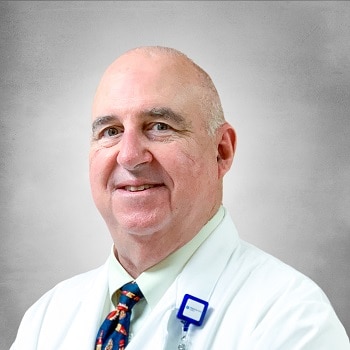
“Paris always had a positive attitude and a lot of motivation to get better, and that helps. After we gave him options that didn’t include amputating his leg, he felt a lot better psychologically, said Dr. Tony Alleman, medical director for wound care & hyperbaric oxygen therapy.
“I had surgery, and they stitched my skin back up,” Paris said. “It was kind of a waiting game from there to see if the skin was going to survive.”
With severe degloving injuries, patients are at risk of tissue death due to a disruption in blood supply. If too much tissue dies, the only option is to amputate the affected limb.
That is the prospect Paris faced before Regional One Health surgeons Xiangxia Liu, MD, PhD, and Derek Asserson, MD came to talk with him about two weeks after his injury.
“I was about a day away from having my leg amputated below the knee. I was scared – it was hard to swallow the fact that it would have to happen,” he said.
“They came in and gave me an alternative. They told me step-by-step what they were going to do. They were very confident, and they made me feel confident too.”
Dr. Liu and Dr. Asserson performed surgery to remove Paris’ injured skin and replace it with a skin substitute. They followed that with a second surgery to take a skin graft from his leg to replace the skin substitute. They did have to amputate three toes, but were able to save his leg.
Paris also received hyperbaric oxygen therapy, a state-of-the-art therapy designed to spark the body’s natural healing processes.
Tony Alleman, MD, medical director for wound care & hyperbaric oxygen therapy, said crush injuries are one of many conditions where hyperbaric oxygen therapy can help.
“Hyperbaric oxygen therapy is a wonderful treatment for a very diverse group of conditions, including diabetic wounds, radiation injuries, and burns,” Dr. Alleman said. “In many cases, it offers a patient their best or even their only chance at recovery. With a crush injury, the damaged tissue has trouble getting oxygen, and hyperbaric oxygen helps with that.”
Regional One Health is home to the only multi-place hyperbaric oxygen chamber in Tennessee. Patients go on a series of “dives” where they are exposed to 100 percent oxygen under pressure, helping build new blood vessels that deliver oxygenated blood to damaged tissue so it can heal.
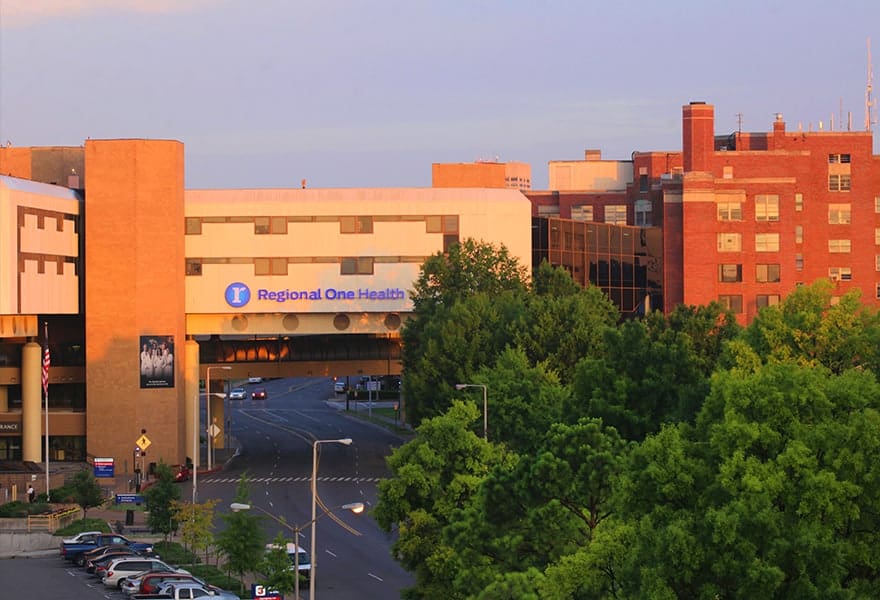
Having a level one trauma center nearby was crucial for Paris. As the only level one trauma center in a 150-mile radius, the Elvis Presley Trauma Center has as an expert team available 24/7 to care for patients with complex, severe injuries.
“For Paris, we used hyperbaric oxygen to salvage as much tissue as we could. They were talking to him about amputation, but we helped salvage most of his foot and his leg,” Dr. Alleman said.
That’s crucial to a patient’s future physical and emotional health, he noted.
“Once you have an amputation, your chances of health problems can go up because there’s less mobility. Amputation, especially for young people, can also cause psychological issues and depression,” Dr. Alleman said. “Paris always had a positive attitude and a lot of motivation to get better, and that helps. After we gave him options that didn’t include amputating his leg, he felt a lot better psychologically.”
For Paris, it was a chance to get back to the things he needs and wants to do.
“Now, I’m in physical therapy. I’m walking,” Paris said. “When I started therapy, I could walk maybe five steps. After a week I was walking without a scooter or crutches or anything.”
Once he recovers, he plans to continue working as an equipment operator. Paris also loves the outdoors, and is excited to get back to some of his favorite adventures.
“I like swimming, hiking, fishing…I’ll even climb up rock cliffs,” he said. “I think that’s something I could be able to do. They were very confident that I was going to be able to get back to all of the things I used to do.”
He said the support he received at Regional One Health is an essential part of that journey. “The doctors and nurses are awesome. They explain everything really well, and they make you feel safe,” Paris added. “I just want to give all the praise to them.”